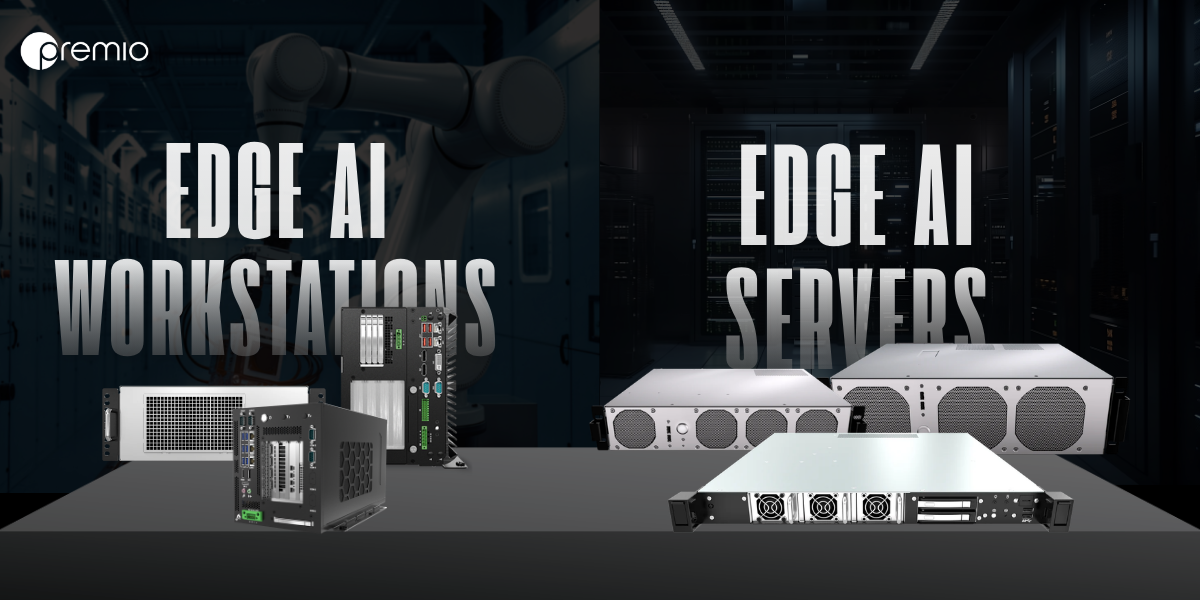
AI is moving closer to where data is created, but not every workload belongs in the same place. Some applications need real-time acceleration near machines, cameras, robots, and inspection systems. Others require centralized on-prem infrastructure to support larger models, multiple users, and shared AI services.
That is why choosing between an Edge AI Workstation and an Edge AI Server is really a question of AI architecture. Workstations bring intelligence closer to machines. Servers centralize AI compute for scalable on-prem deployment.
The right choice depends on where the workload should run, what it needs to connect to, and how the AI infrastructure needs to scale.
Why On-Prem AI Needs a Hardware Strategy
On-prem AI is not one-size-fits-all. Some workloads need real-time compute beside machines, cameras, robots, or inspection systems. Others need centralized infrastructure to support larger models, multiple users, and shared AI services.
That is why hardware selection should start with workload placement. Where is the data created? How fast does the AI need to respond? What does the system need to connect to? Does the workload serve one machine, one line, or multiple teams?
The answers help define whether the right fit is a machine-side Edge AI Workstation, a centralized Edge AI Server, or a layered architecture that uses both.
Distributed Edge AI Inference vs. Centralized On-Prem AI Infrastructure
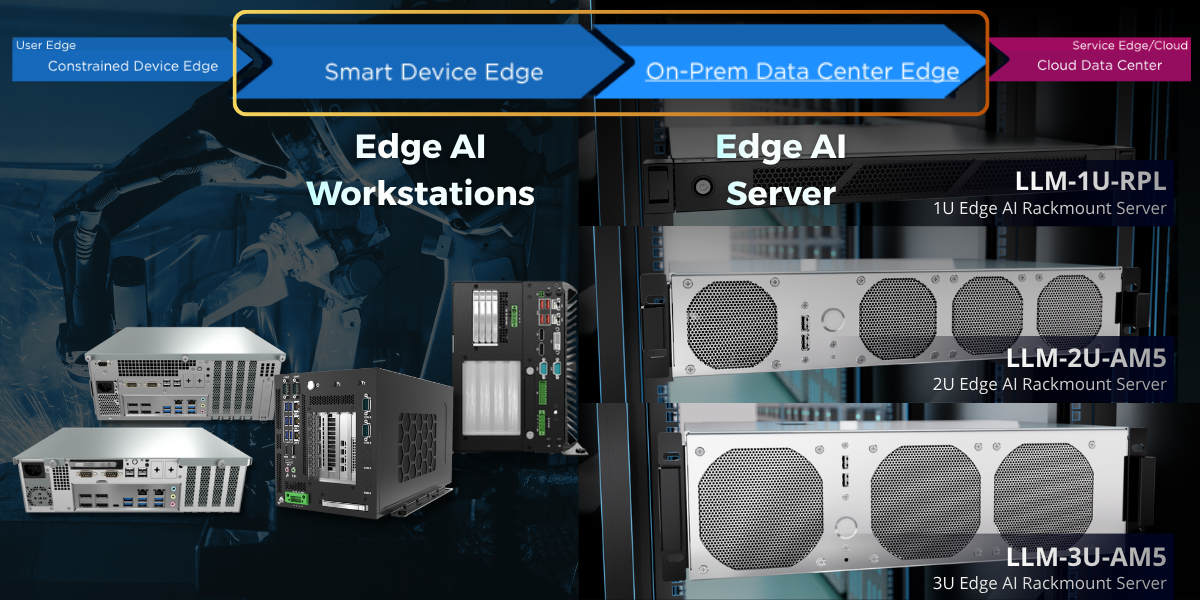
Choosing between an Edge AI Workstation and an Edge AI Server starts with one question:
Where should the AI workload run?
Some workloads need to run close to machines, cameras, robots, or inspection systems. Others need to run from a centralized on-prem infrastructure layer that supports larger models, multiple users, and shared AI services.
Edge AI Inference Close to Equipment
This is where an Edge AI Workstation fits best.
It supports real-time AI inference near the source of data, making it a strong choice for machine vision, robotics, AI inspection, video analytics, and industrial automation.
The goal is simple: process data locally, reduce latency, and support faster decisions near the operation.
Centralized On-Prem AI Infrastructure
This is where an Edge AI Server fits best.
It supports larger AI workloads from a server room, rack, control room, or secure micro data center. This makes it ideal for on-prem LLMs, multimodal AI, shared AI services, and private AI infrastructure.
The goal is to centralize compute, support multiple users or applications, and maintain control before data is relayed to the cloud.
What Is an Edge AI Workstation?
An Edge AI Workstation is an industrial AI computer that brings accelerated Edge AI inference closer to machines, cameras, sensors, robots, and production equipment. Built for operational environments, it combines GPU acceleration, PCIe expansion, high-speed storage, and flexible deployment in a workstation-class system.
Its role is to process AI workloads near the data source, helping reduce latency, limit data movement, and support faster local decision-making.
Edge AI Workstations are best for:
- Edge AI inference near equipment
- Vision AI and machine vision
- Robotics and autonomous systems
- AI inspection and quality control
- Video analytics
- Industrial automation
- GPU-accelerated workloads near cameras, sensors, and machines
Simple way to think about it:
Choose an Edge AI Workstation when AI inference needs to run close to equipment, cameras, sensors, robots, or production systems.
What Is an Edge AI Server?
An Edge AI Server is a centralized on-prem AI infrastructure system deployed at the On-Prem Data Center Edge, such as a secure micro data center, server room, control room, or rackmount environment.
It acts as the final on-prem compute layer before data moves to the cloud, supporting on-prem LLMs, multimodal AI, agentic AI, and shared AI services across multiple users, models, systems, or applications.
Edge AI Servers are best for:
- On-prem LLMs and multimodal AI
- Agentic AI and centralized inference
- Multi-user AI services
- Private AI infrastructure
- AI workload consolidation
- Secure micro data center deployments
- Hybrid cloud AI architectures
Choose an Edge AI Server when AI needs to operate as a centralized on-prem compute layer before data is relayed to the cloud.
Key Differences: Edge AI Workstation vs. Edge AI Server
Criteria
Edge AI Workstation
Edge AI Server
Deployment location
Near machines, cameras, robots, inspection lines, or work cells
Server room, control room, rack, or micro data center
Main purpose
Machine-side AI acceleration and local inference
Centralized LLM, multimodal AI, and workload consolidation
Form factor
Industrial workstation, wall-mount, rugged chassis, or machine-side system
1U, 2U, or 3U rackmount server
Best workload
Vision AI, robotics, inspection, video analytics, localized AI apps
On-prem LLMs, agentic AI, multimodal AI, multi-user AI services
Expansion focus
GPU, PCIe, I/O, local storage, and deployment flexibility
GPU density, high-speed networking, remote management, and infrastructure scalability
Primary users
Automation teams, machine builders, robotics teams, vision system integrators
IT, OT, AI infrastructure teams, enterprise AI teams
Decision driver
Proximity to equipment and real-time response
Shared compute resources and centralized AI infrastructure
When to Choose Each One
The right choice starts with workload placement: where the AI needs to run, what it needs to connect to, and how broadly it needs to scale.
Choose an Edge AI Workstation when…
Choose an Edge AI Server when…
AI inference needs to happen close to machines, cameras, robots, or inspection systems
AI compute needs to serve multiple users, models, systems, or applications
The workload is tied to a production line, work cell, or localized operation
The workload belongs in a rack, server room, control room, or micro data center
Low latency, local data processing, GPU acceleration, or direct equipment connection is the priority
Centralized compute, high-speed networking, private AI infrastructure, or shared AI services are the priority
Best fit: vision AI, robotics, inspection, video analytics, and industrial automation
Best fit: on-prem LLMs, multimodal AI, agentic AI, and centralized inference
In simple terms: use an Edge AI Workstation when AI needs to make decisions close to the operation. Use an Edge AI Server when AI needs to scale as a shared on-prem infrastructure layer.
Premio x86 Edge AI Workstations
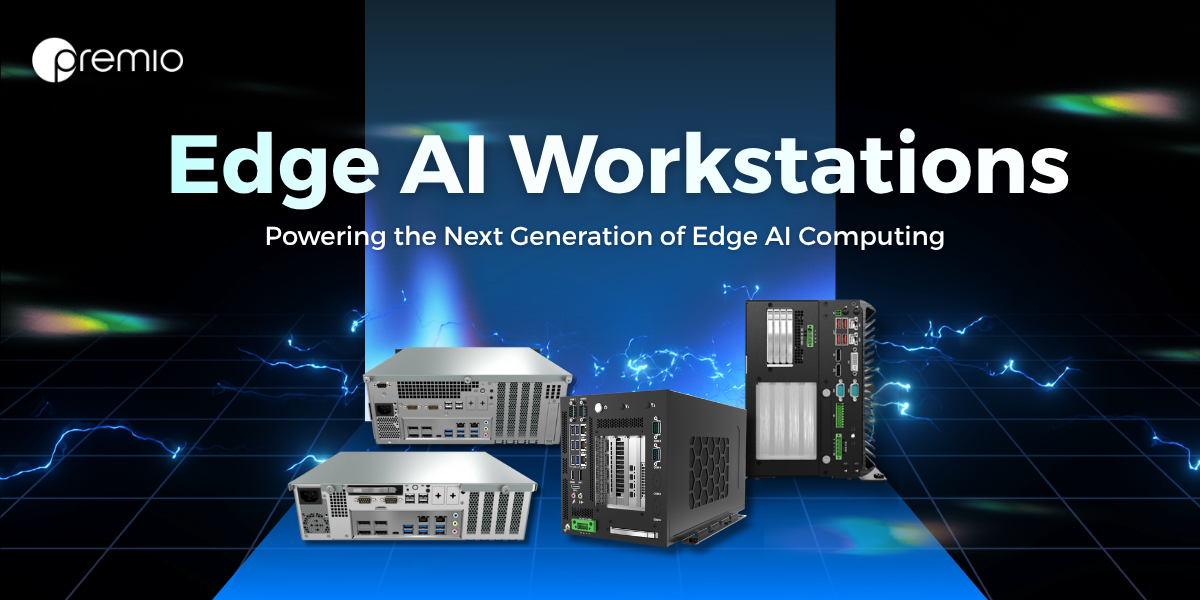
Best for: Edge AI inference, robotics, machine vision, AI inspection, and localized industrial AI.
Premio’s x86 Edge AI Workstations are designed for AI workloads that need to run close to cameras, machines, robots, and industrial equipment. These systems support scalable AI deployment for vision AI, robotics, machine vision, video analytics, and industrial automation applications.
The workstation portfolio includes KCO Series and VCO Series systems for different levels of performance, expandability, and rugged deployment needs.
Key deployment fit:
- Vision AI and inspection
- Robotics and automation
- GPU-accelerated industrial workloads
- PCIe expansion for add-on cards
- Local storage and data processing
- Factory-floor or equipment-level deployment
Explore Premio x86 Edge AI Workstations >>
Premio Edge AI Server: LLM Series
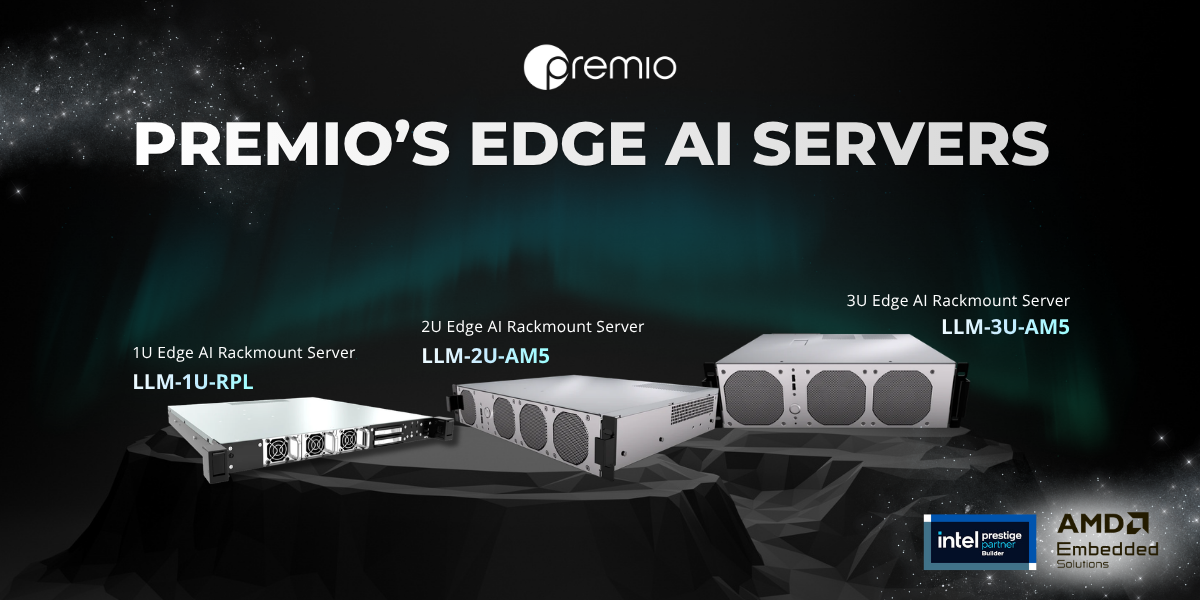
Best for: On-prem LLMs, multimodal AI, agentic AI, centralized inference, and private AI infrastructure.
Premio’s LLM Series Edge AI Servers are designed for rackmount on-prem AI infrastructure. These systems support secure and real-time processing for local AI and LLM workloads, helping organizations deploy advanced AI closer to where data is generated while maintaining control before data is relayed to the cloud.
For larger rackmount deployments, Premio’s LLM Series provides a scalable server option for on-prem AI infrastructure, private AI services, and centralized AI workloads.
- On-prem LLM deployment
- Multimodal AI workloads
- Agentic AI applications
- Centralized AI compute
- Rackmount or micro data center deployment
Explore Premio Edge AI Servers >>
Simple Selection Framework: Which One Do You Need?
Use this section to make the article more useful and less like a definition blog.
Question
Choose Edge AI Workstation If…
Choose Edge AI Server If…
Where does AI need to run?
Near machines, cameras, robots, or sensors
In a rack, control room, server room, or micro data center
Who uses the compute?
One machine, one line, or one localized application
Multiple users, systems, models, or applications
What is the main workload?
Vision AI, robotics, inspection, local inference
LLMs, multimodal AI, agentic AI, centralized inference
What matters most?
Low latency and local deployment flexibility
Compute consolidation and infrastructure scalability
What does it connect to?
Cameras, sensors, machines, industrial I/O, robotics systems
Networks, storage, users, models, and AI services
Final Takeaway: Start with the Deployment Model
The difference between an Edge AI Workstation and an Edge AI Server is not only about form factor. It is about where the AI workload runs and how the compute resources are used.
An Edge AI Workstation is the right choice when AI needs to operate close to machines, cameras, robots, and production systems.
An Edge AI Server is the right choice when AI needs to support centralized LLMs, multimodal workloads, multiple users, or multiple applications from an on-prem infrastructure layer.
For many industrial AI deployments, both can work together. Workstations bring real-time intelligence to the machine level, while servers provide centralized AI infrastructure for larger models, shared compute, and private AI services.