
Large Language Models (LLMs) are driving today’s generative AI applications — from chatbots to enterprise assistants. While cloud deployment remains the default, not all workloads benefit from sending data to centralized servers. For real-time inference, data privacy, or offline scenarios, Edge LLMs bring AI closer to the source. As model deployment expands, choosing between cloud and edge becomes a strategic decision — driven by performance, cost, and control. At the same time, Small Language Models (SLMs) are emerging as a lightweight alternative at the edge, enabling efficient, task-specific AI on compact devices. In this blog, we compare cloud LLMs, Edge LLMs, and SLMs, and explain how model size and deployment scope shape your AI infrastructure.
Cloud LLM Deployment for Large-Scale AI Applications
Large Language Models (LLMs), typically ranging from billions to hundreds of billions of parameters, are most commonly deployed on cloud AI infrastructure. These cloud-based LLM deployments rely on massive GPU clusters, high-bandwidth networking, and large-scale storage to support the training and inference of advanced AI models. Cloud LLMs are ideal for large-scale AI applications that require broad language understanding across multiple industries, including customer service chatbots, SaaS AI platforms, content generation tools, and enterprise virtual assistants. By hosting LLMs in the cloud, organizations can easily scale AI workloads, leverage managed AI services, and access the latest model updates without the need for on-premise hardware.
The Limitations of Cloud LLM Deployment
As enterprise adoption expands, more organizations are encountering limitations that cloud infrastructure alone may not fully address — particularly around data privacy, latency, operational cost, customization, and compliance. These challenges include:
- Data Privacy: Sensitive data must be transmitted to third-party servers, raising concerns for regulated industries
- Latency: Cloud inference depends on network stability, making real-time processing difficult for time-sensitive applications
- Cost: Continuous inference workloads lead to high and unpredictable cloud computing expenses
- Control: Limited flexibility to customize or fine-tune models for specific enterprise tasks
- Compliance: Increasing AI regulations require stricter control over data residency and model governance.
Growing Enterprise Demand for Private AI
- Maintain full control over sensitive data
- Customize models for task-specific requirements
- Comply with data residency and sovereignty regulations
- Reduce dependency on third-party infrastructure
- Lower long-term operating costs
- Achieve real-time AI inference directly at the data source
Edge LLM Deployment for Private, Low-Latency AI
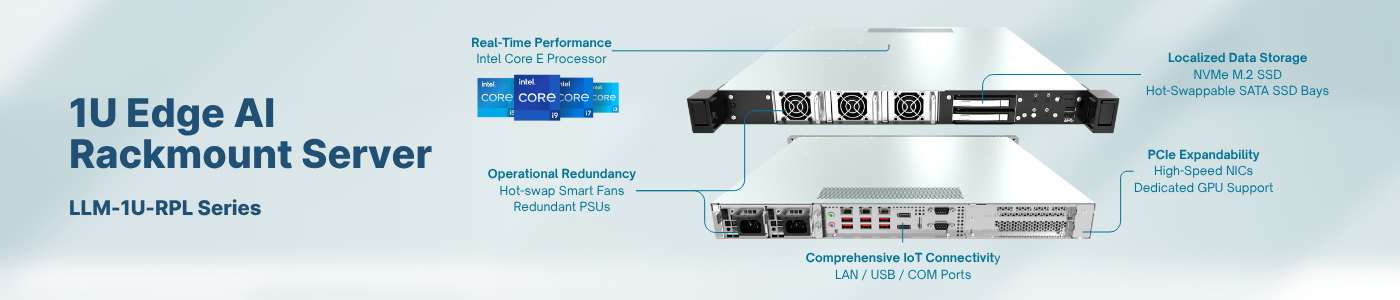
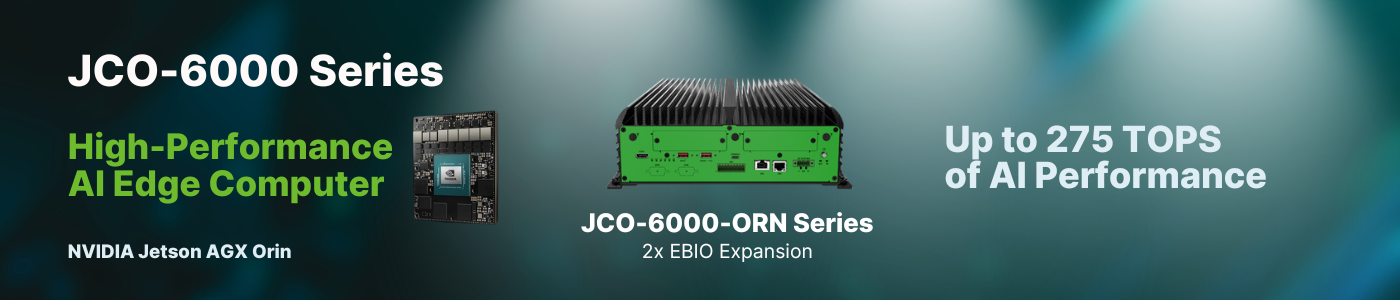
Edge LLM deployment brings large language models closer to where data is generated and decisions are made — running directly on local servers, edge AI computers, or industrial systems. Instead of relying on cloud infrastructure, Edge LLMs process data locally while delivering advanced AI capabilities. Edge LLMs are increasingly adopted in industries such as manufacturing, healthcare, transportation, defense, and smart cities — where AI workloads require real-time inference, strict data handling, and continuous operation, even in environments with limited or unreliable network connectivity. Running LLMs at the edge requires specialized hardware capable of supporting high-performance inference, including edge servers with GPUs, AI accelerators, or NPUs optimized for language model workloads.
Edge LLMs vs SLMs: Choosing the Right AI Model for the Edge
Real-World Use Cases for Cloud LLMs, Edge LLMs, and SLMs
Hybrid AI Deployment: Combining Cloud LLMs and Edge Inference
- Training and foundation model updates are handled in the cloud, where large-scale compute resources are available.
- Inference and real-time responses are performed at the edge using smaller, task-optimized models.
Conclusion:
- Cloud LLMs are well-suited for large-scale, general-purpose applications that require massive compute and centralized infrastructure.
- Edge LLMs offer a solution for high-performance, privacy-sensitive inference at the edge, where localized control and low latency are critical.
- SLMs enable efficient, task-specific AI directly on compact edge devices, bringing intelligence to environments with limited space, power, and connectivity.