Moving Beyond the "Lab-Grade" Mentality
Why the 3.5" Form Factor is the "Goldilocks" of Industrial Design
- Rich I/O in a Small Footprint: It’s small enough to fit inside tight enclosures but large enough to host multiple LAN ports, USB connections, and expansion slots.
- Thermal Efficiency: The surface area of a 3.5" board allows for better heat dissipation, which is critical for fanless designs.
- Standardization: The 146mm x 102mm dimensions make it easy for system builders to swap or upgrade boards without redesigning the entire chassis.
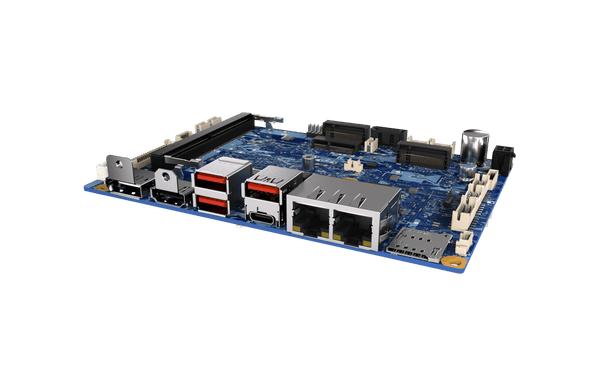
Spotlight: The Premio CT-DAS01 – Powered by Intel® Atom® x7000RE
To understand where the industry is heading, look at the Premio CT-DAS01. This isn't just another motherboard; it’s a purpose-built engine for the next generation of industrial applications.
- Industrial-Grade AI Acceleration: The series features Intel® Deep Learning Boost (Intel® DL Boost) and support for the OpenVINO™ toolkit, enabling high-performance AI inference directly at the edge.
- Low-Power Efficiency: With a Thermal Design Power (TDP) as low as 6W to 12W, these processors allow for completely fanless, high-uptime operation in challenging environments.
- Edge-Specific Features: Built-in support for Intel® Time-Coordinated Computing (Intel® TCC) and Time-Sensitive Networking (TSN) ensures predictable, smooth operation for latency-sensitive industrial workloads.
What Makes the CT-DAS01 Different?
- True Industrial Range: It is engineered for the full -40°C to 85°C spectrum, ensuring uptime in extreme hot or cold.
- Connectivity at the Edge: With dual 2.5GbE LAN ports, it handles high-bandwidth data from industrial cameras or sensors with ease.
- Modular Flexibility: It features M.2 slots for NVMe storage, 5G connectivity, and AI modules, allowing the system to grow with your needs.
- Power Resilience: Its 9~36V wide voltage input protects the system from the "dirty power" common in vehicles and factories.
The ROI of Reliability: Total Cost of Ownership (TCO)
- Downtime: Every minute a system is offline costs money.
- Truck Rolls: Sending a technician to a remote site to replace a failed board can cost ten times the price of the hardware itself.
- Redesign Costs: If a consumer board goes end-of-life after 18 months, you have to spend weeks re-validating a new model.