In the big world of processors, Intel has taken a revolutionary step in changing the architecture and upgrading the performance of CPUs in the 12th and 13th generations. With the launch of its hybrid architecture, Intel has once again secured a leading position in CPU performance, a title AMD held with its Ryzen 5000 series. The P cores (Performance cores) and E cores (Efficiency cores) are not only technological advancements but also Intel's vision of future computing.
- What is the motivation for Intel to launch hybrid architecture cores?
- What is P core?
- What is E core?
- How is the performance when P core and e core work together?
- What is the difference between P core and E core?
- How Intel P and E cores is better than Intel previous architecture?
- What is the Intel Thread Director Technology?
- Leverage P cores and E cores with Windows 11
- How does hybrid architecture affect embedded systems?
What was the motivation for Intel to launch hybrid architecture cores?
Intel's shift to CPUs with different core types stems from the need to cater to varied computing tasks in the modern digital landscape. This hybrid approach combines the power of P cores for intensive tasks with the energy efficiency of E cores for lighter background operations. Such a design not only boosts multitasking and manages thermal outputs but also ensures competitiveness in the market against architectures like ARM's "big.LITTLE." Ultimately, Intel's heterogeneous core design aims to balance power and efficiency, adapting to current and future computing demands.
What is a P core?
"P core" refers to "Performance core" in Intel's hybrid architecture introduced with the Alder Lake series of processors. The P core is designed for high-performance tasks. It is optimized to handle demanding workloads that require more computational power.
The P core typically has a more complex design with larger caches and more advanced features that boost performance. It is built to achieve higher clock speeds and offers greater per-thread performance. Currently, Intel uses the Golden Cove microarchitecture for the P cores in its 12th Gen CPUs and the Raptor Cove microarchitecture for the P cores in its 13th Gen CPUs. These technologies follow the Cypress Cove cores used in the Rocket Lake 11th Gen Intel CPUs.
What is a E core?
"E core" refers to "Efficiency core." E cores are designed to handle lighter, routine tasks focusing on energy conservation. Their primary aim is to ensure that the system remains responsive and efficient, even when it's not being pushed to its limits. Simpler in structure compared to P cores, E cores consume less power and produce less heat. This design ensures that the CPU can function efficiently for many everyday tasks without drawing unnecessary power or generating excessive heat.
The E cores in Intel's 12th and 13th Gen CPUs are built using the Gracemont microarchitecture. This Gracemont design succeeds Intel's Tremont technology, which initially debuted in Intel Pentium Gold and Celeron laptop CPUs. Notably, the clock speed of the Intel E cores is typically lower than that of the P cores, often hovering around 700 MHz.
How is the performance when P cores and E cores work together?
Source: Intel
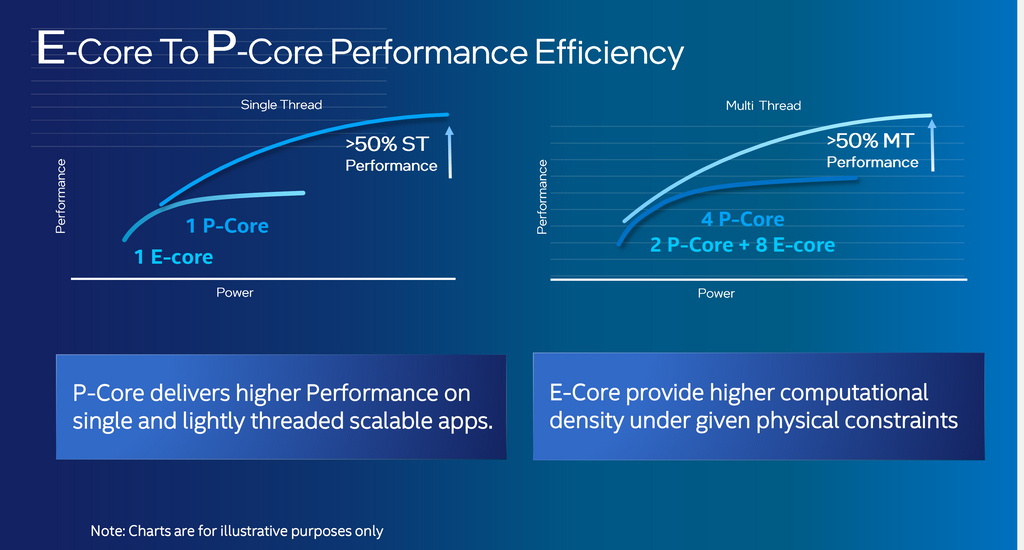
The collaboration between P and E cores in Intel's hybrid architecture marks a strategic evolution in CPU design. This architecture is akin to having sprinters (P cores) and marathon runners (E cores) on the same relay team, where each type of runner is chosen for the most suitable part of the race. While P cores are focused on delivering peak performance for intensive workloads, E cores ensure that the system runs efficiently during regular use. The synergy between P and E cores in a single chip allows the CPU to adapt dynamically to varying workloads, balancing power and performance. By distributing workloads between P and E cores, the CPU can effectively manage heat generation. While P cores can generate more heat due to their high-performance nature, E cores tend to be cooler due to their efficiency-oriented design.
The distinction between P and E cores reflects a broader industry trend towards embracing heterogeneity in CPU design, allowing for a more dynamic and adaptive allocation of tasks based on their nature. This aims to give users the best balance between power and performance in various computing scenarios.
How are Intel P and E cores better than Intel's previous architecture?
Intel's 12th Gen chips utilize a combination of P-Cores and E-Cores that collaborate efficiently. The P-Cores in these chips deliver a performance improvement of 19% compared to those in the 11th Gen Intel Core. Meanwhile, E-Cores boasts a 40% enhanced performance at the same power level as the single Skylake core.
What is Intel's Thread Director Technology?
Intel introduced the Intel® Thread Director, which debuted with the 12th Gen CPUs. Intel Thread Director is a hardware e-based feature that works in conjunction with the operating system's scheduler. Its primary function is to intelligently allocate and schedule tasks to the most appropriate cores (p core or e core) based on their current workload and requirements.
- It observes the specific instructions of each thread and the status of each core, doing so with remarkable nanosecond accuracy.
- It communicates with the operating system, offering feedback to ensure the best task allocation for every workload.
- Its recommendations adjust in real-time, based on the system's Thermal Design Point (TDP), current operational environment, and energy configurations.
Leveraging P cores and E cores with Windows 11
Windows 11 is primed to leverage Intel's P and E cores more effectively than Windows 10. With its refined thread scheduling and native support for Intel's Thread Director, Windows 11 smartly assigns tasks to the most suitable core. This synergy results in enhanced multitasking, optimized power management, and a more responsive user experience. In essence, Windows 11 has been tailor-made to capitalize on the advancements of Intel's hybrid architecture fully.
Read more: Should You Upgrade Windows 11 from Windows 10 IoT?
Premio’s embedded computer, RCO-6000-RPL
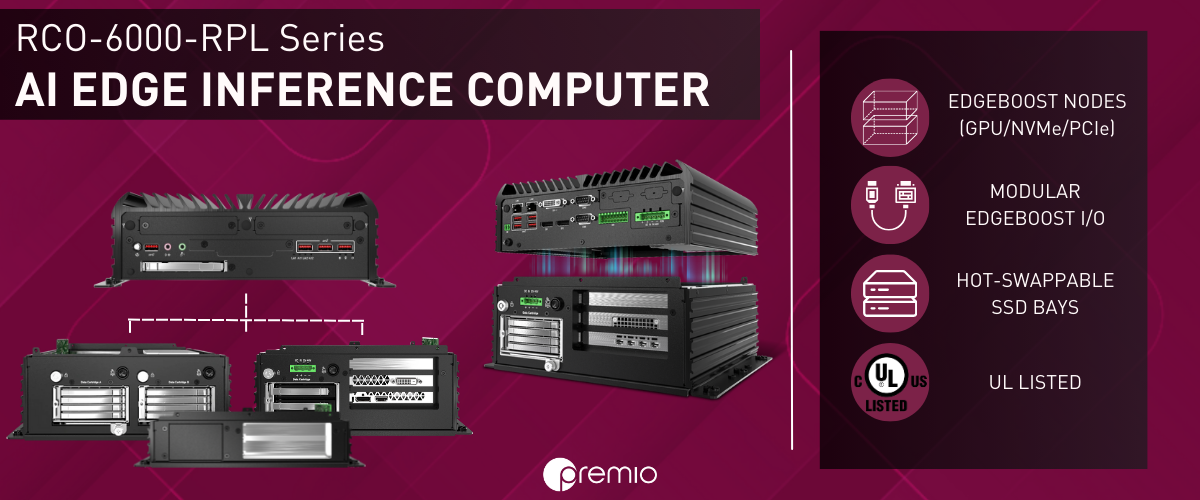
Industrial Fanless Computer with Intel P&E cores
RCO-6000-RPL Series is a high-performance, fanless industrial computer that utilizes the Intel P and E cores to achieve powerful edge performance in harsh environments.
- LGA 1700 socket for 12/13th Gen. Intel® ALD-S & RPL-S Processor (35W TDP)
- Intel® R680E Chipset
- 2x DDR5 4800/5600MHz
- 8x DI + 8x DO with isolation
- Wide Operating Temperature -25°C to 70°C
Frequently Asked Questions (FAQ)
Is P core better than E core?
It's not a matter of "better"; rather, they serve different purposes. P core are optimized for high-performance tasks, while E core are designed for energy efficiency and background tasks.
Does more cores mean more power consumption?
Generally, adding more cores can increase power consumption, but it depends on the core's design, utilization, and the tasks being performed. E cores, for instance, are designed to use less power.
Can P cores and E cores be managed separately?
Yes, modern operating systems, with the help of technologies like Intel Thread Director, can intelligently assign tasks to the appropriate core based on the task's nature and current system demands.
Which core is better suited to multitasking?
Both types contribute to multitasking. P cores handle demanding tasks, while E can efficiently manage background or lighter tasks. Together, they enhance the multitasking experience.
How do P and E cores impact thermal performance?
The hybrid design can lead to better thermal performance. E cores can handle tasks without generating as much heat as a P core, potentially leading to cooler device operation under specific workloads.